Roll that Rye!
by Harriet Behar
This article was first printed in the July/August 2010 issue of the Organic Broadcaster, published by the Midwest Organic and Sustainable Education Service.
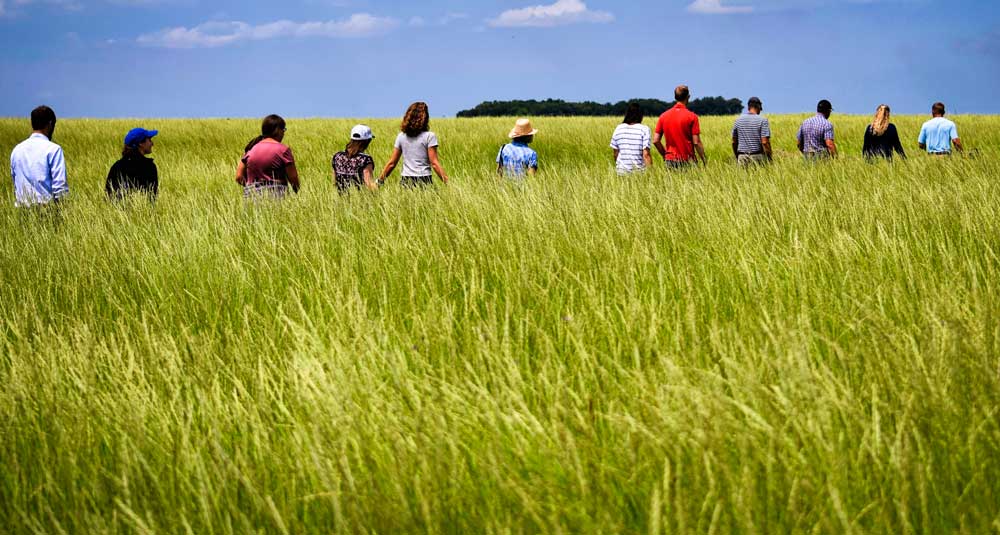
Organic farmers tend to be “early adopters” of agricultural practices that can enhance their soil and protect their natural resources. Rolling and crimping a rye or hairy vetch crop and planting soybeans or corn into that crop is one such practice that accomplishes these goals. On June 7, 2010, the Vernon County Conservation Department, the Natural Resources Conservation Service (NRCS), the UW Arlington Research Station, and MOSES combined their energies to put on an organic no-till planting demonstration at land managed by Ed Knoll just south of Sparta, WI. Thanks to Organic Valley and MOSA for providing refreshments.
Organic no-till offers very similar benefits to cover cropping: it improves soil tilth, lessens soil erosion, improves water and air infiltration into the soil, encourages soil biological life, suppresses weeds, controls nitrogen leeching, increases soil organic matter, lessens sediment accumulation in neighboring surface waters, lessens compaction and can prevent springtime water logging in fields that are poorly drained. With this list of benefits, no wonder over 65 people attended the field day, with a mixture of NRCS conservation personnel, soil consultants and farmers all actively reviewing the rolling/crimping and planting in a variety of settings.
Ed Knoll, a long time and committed organic farmer and owner of Golden Grains organic feeds, put some forethought into the planting of the rye last fall. He planted the fields at a variety of rates: 2 bushel per acre, 3 bushel per acre and 4 bushel per acre. This gave the attendees the opportunity to observe the effectiveness of the roller/crimper on these various planting densities as well as the probable effectiveness for moisture retention and weed control of this killed rye mulch. The fields were also planted both with a no-till drill (whose use was donated by the local John Deere dealer), and with Ed’s 4 row planter. The roller crimper is filled with water to give it more weight. The chevron pattern bars on the roller are placed to prevent bouncing, and provide many areas of contact to crimp the cover crop (about one crimp for every 7 inches).
With each pass of the roller/crimper and planter the attendees assessed the number of bruises and crimps on the rye. The crimps kill the rye and prevent it from becoming a weed. We also observed the penetration of the soybean seed planted through the mulch by the two different planters. The two- and three- bushel per acre fields were on side hills, and the four-bushel per acre field was on flat ground. It appeared that the best seed penetration of both types of planters was on the flat field, even though the four bushel per acre also made a much thicker mat. It also seemed that the four bushel per acre rye responded with better crimping by the roller, perhaps due to the volume of biomass that was being rolled. The two bushel per acre field had bare spots where it appeared weeds could grow up through the mulch, and possibly lessen yields due to weed pressure. The UW experimental station in Arlington typically plants the rye at four bushel per acre to make sure they have a good strong stand the following spring.
There will be a follow up field day to look at the same fields on September 20, to assess the various rye densities and planting types. This event is free and open to anyone, see the MOSES event calendar on page 20 for more information.
Erin Silva, UW Madison Organic Research Coordinator, started out this field day by presenting research being done at the UW, Michigan State and by the pioneers of this rolled/crimped mulch method, the Rodale Institute in Pennsylvania. In Wisconsin, researchers have also experimented with mowing the rye at the same time as you would roll it (at pollination, when it is just starting to form a seed head). Sickle mowing was almost as good a method for killing the rye as crimping, however the flail mowed rye did not allow the planter to open a furrow, which the crimper does.
It is important to plant the seed crop in the same direction as the field is rolled or mowed to allow the planter coulters to push aside the long stalks of rye and expose some dirt for planting the seed. Erin stated that the UW has not had much luck with rolling hairy vetch. Rodale has not perfected this rolled mulch, although more experimentation might lead to using this high nitrogen producing cover as a rolled or mowed mulch in the future.
During our demonstration some soybean seed was found above the soil surface, and Erin stated that they have added weights to their drill at UW Arlington to solve this issue. The row crop planter appeared to penetrate better than the drill used in our demonstration at the field day.
Vegetable growers have also successfully used this killed rye mulch method, usually with cucurbits like summer squashes or pumpkins. They use a water wheel transplanter to go through either sickle or flail mowed rye. Since this type of transplanter usually plants through plastic, it seems to be effective in penetrating the mulch cover through different types of mowing.
Erin discussed some of the drawbacks of planting into crimped or mowed rye, including the possibility of a thinner crop stand due to the potential difficulty of getting the seed buried in the soil. There is also the chance of a lesser yield, due to the later planting of the soybeans, since it is best to wait to crimp or mow until the rye is pollinating, yielding fewer dollars per acre. However, this no till offers benefits that may offset these issues, such as good weed management without tillage, and without the time and fuel needed to perform rotary hoeing and cultivating. The soil is covered with a living crop or a thick mulch for between 14 and 17 months If you count the months from the planting of the rye sometime between September to November the previous fall through the cash crop for a full 12 months up until the spring of the year after the crop was harvested, you have a very long time of untilled ground while still producing a high value crop This extended time when the ground is managed in this way can contribute to lesser compaction in fields where many years of row crops are typically grown in rotation, since the farmer is still growing a “row crop” in rotation, but without tillage and with the incorporation of many tons of biomass.
This year with its early spring and warm temperatures provided good growing conditions for the rye, even though it was planted late in November last year. Typically, in order to be more assured of a good thick stand, farmers plant the rye to be rolled the next year in early to mid September in southern Wisconsin, after taking off an earlier small grain crop or corn silage. Ed harvested corn for grain last year from this field, and with the wet fall, it was difficult to get the rye in any earlier. However, the weather cooperated this spring and the rye was a nice thick stand. If the stand is not thick, the farmer may decide it is better to till it in as a cover crop, since the strong inevitability of a field growing more weeds than beans in a wimpy rye mulch would lead the farmer to tillage rather than rolling that rye.
Many thanks to Ed for providing the fields for experimentation and his inspiring words about organic agriculture. I know I plan to visit this field again on September 20 to see how the various plantings yielded and how well the rolled rye experiment performed.
Harriet Behar is the MOSES Outreach Specialist. She was an organic inspector and inspector trainer for many years and has an organic bedding plant and vegetable operation with her husband in Southwest WI.
Return to TOP